Cybersecurity Compliance for Regulated Businesses in Georgia
-1.jpg?width=48&height=48&name=highres_casgar_04%20(1)-1.jpg)
Adam M. Casgar
Cybersecurity Compliance for Regulated Businesses in Georgia
9:11
If you run a regulated business in Georgia -- a medical practice, a law firm, a dental office, a financial services company, or any organization that handles sensitive client data -- cybersecurity is not just an IT issue. It is a business risk, a compliance concern, and a trust issue.
Most business owners don't spend much time thinking about security until something brings it into focus. A client asks how their data is protected. A regulator wants more detail. You hear about another business dealing with an incident. That's usually when the questions start:
Who can access your systems?
Where is your data stored?
How well is it protected?
Are backups being monitored?
Could you explain your security controls if a client, auditor, insurer, or regulator asked?
Those are the questions regulated businesses need to be able to answer. This guide is written to help you get there.
What does cybersecurity compliance mean for Georgia businesses?
Cybersecurity compliance means your business has the right policies, tools, safeguards, and processes in place to protect sensitive data and reduce risk.
For some Georgia businesses, compliance may be tied to industry-specific requirements. Medical offices may need to consider HIPAA. Financial businesses may need stronger data protection and access controls. Law firms may need to protect confidential client information. Schools, nonprofits, contractors, and professional service firms may also face expectations from clients, insurance providers, vendors, or governing bodies.
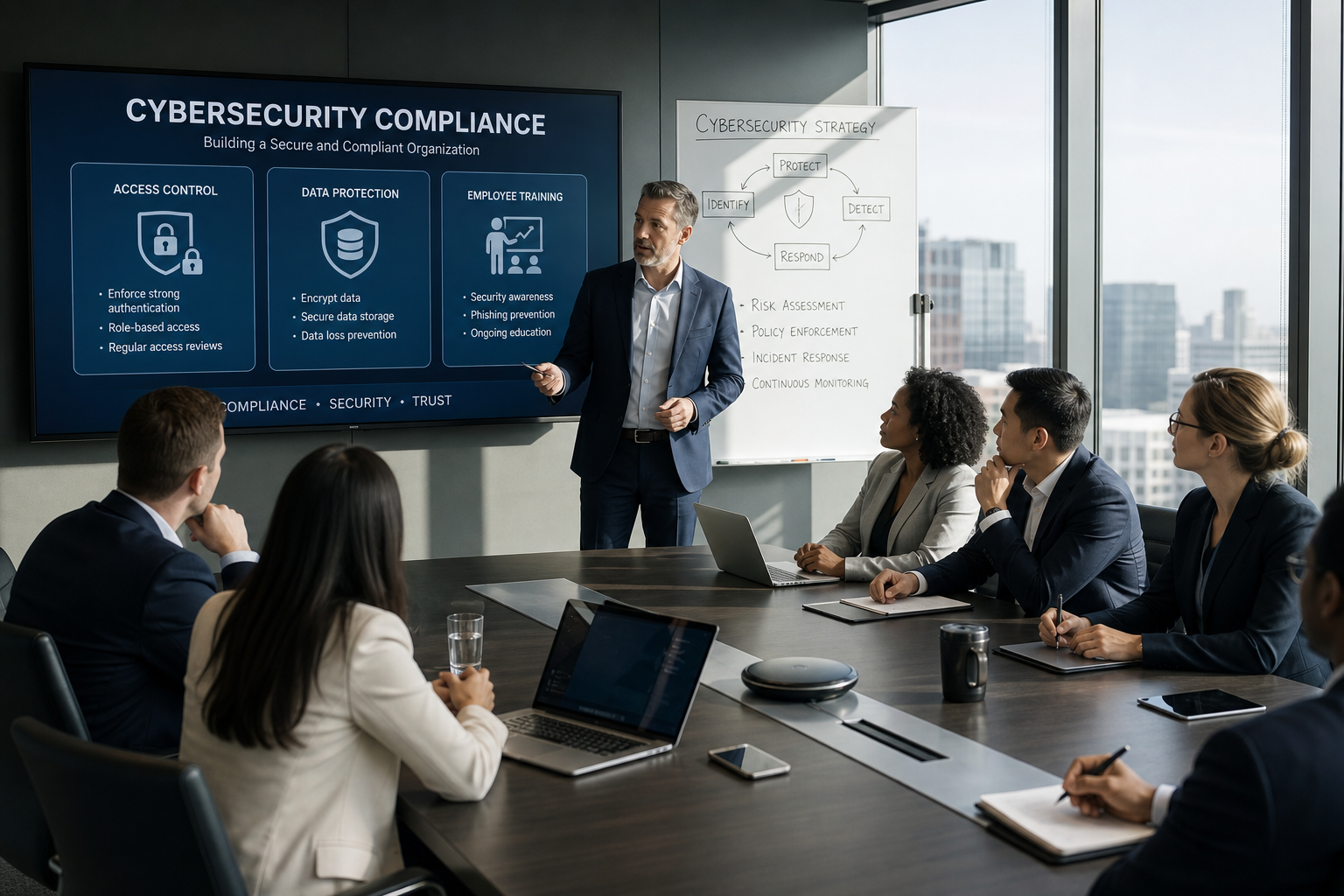
The exact requirements depend on your industry, but the foundation is usually the same: protect access, secure data, monitor systems, train employees, maintain backups, and document what is being done.
Which Georgia businesses need compliance-based cybersecurity?
Compliance-based cybersecurity is important for any business that handles sensitive information or has outside expectations around data protection. This often includes:
- Medical practices
- Dental offices
- Law firms
- Financial service businesses
- Accounting firms
- Insurance agencies
- Schools and education organizations
- Nonprofits
- Government contractors
- Professional service firms
- Businesses that store customer payment information
- Companies with remote employees or cloud-based systems
Even if your business is not formally regulated by one specific law, your clients, vendors, cyber insurance provider, or industry partners may still expect you to have clear cybersecurity protections in place.
Why basic IT support is not enough for regulated businesses
Basic IT support usually focuses on keeping computers, networks, email, and software working. That matters, but it is not the same as cybersecurity compliance.
A regulated business needs to know more than whether the printer works or whether someone can reset a password. You need to know whether access is controlled, whether data is backed up, whether employees are using secure login methods, whether systems are monitored, and whether your business could respond quickly if something went wrong.
Cybersecurity should not be treated as an optional add-on. For regulated businesses, it should be part of the foundation.
What should cybersecurity services include for regulated businesses?
When evaluating cybersecurity providers in Georgia, look for services that go beyond one tool or one-time setup. A strong cybersecurity provider should help with:
Access control
Your business should know who has access to systems, files, email, cloud tools, and sensitive data. Access should be based on job role, not convenience. Former employees, outdated accounts, and unnecessary permissions can create unnecessary risk.
Multi-factor authentication
Multi-factor authentication adds another layer of protection beyond a password. For regulated businesses, this is one of the most practical ways to reduce the risk of unauthorized access.
Endpoint protection
Every computer, laptop, and server connected to your business needs protection. Endpoint security helps detect and block threats before they spread through your environment.
Email security
Email is one of the most common ways cyber threats reach employees. A cybersecurity provider should help protect against phishing, malicious attachments, suspicious links, and business email compromise attempts.
Backup and disaster recovery
Backups are not just about saving files. They are part of your business continuity and incident response plan. Your provider should help ensure backups are monitored, tested, and recoverable. The question is not whether you have a backup -- it is whether you could restore everything from a backup taken in the last 24 hours and be operational again quickly.
Security monitoring
Regulated businesses need visibility into what is happening across their systems. Monitoring helps identify suspicious activity, system issues, and potential risks before they become larger problems.
Employee cybersecurity training
Employees are often the first line of defense. Training helps them recognize phishing, suspicious requests, unsafe links, password risks, and social engineering attempts.
Policy and documentation support
If someone asks how your business protects data, you should not have to guess. A good cybersecurity provider can help you document security practices, access controls, backup processes, acceptable use policies, and other important safeguards.
What questions should regulated businesses ask a cybersecurity provider?
Before choosing a cybersecurity provider, ask direct questions:
- Do you have experience working with regulated businesses?
- What cybersecurity services are included in your standard support?
- How do you help control access to sensitive data?
- Do you help with documentation and security policies?
- How do you monitor backups and confirm they are working?
- What happens if we suspect a cybersecurity incident?
- Do you provide employee cybersecurity training?
- How do you help businesses prepare for cyber insurance or client security questions?
- Can you support cloud, remote work, and Microsoft 365 security?
- Will you review our security regularly or only respond when something breaks?
The answers to these questions will tell you a lot about whether a provider is truly security-focused or simply offering basic IT support with security tools added on.
What are common cybersecurity gaps in regulated businesses?
Many regulated businesses do not have one major cybersecurity problem. Instead, they have several smaller gaps that build up over time. Common issues include:
- Too many employees with unnecessary access
- Former employee accounts that were never fully removed
- Weak or reused passwords
- No multi-factor authentication
- Backups that are not being tested
- Cloud files shared too broadly
- No clear cybersecurity policies
- Employees who have not been trained on phishing
- Outdated devices or unsupported systems
- No clear plan for responding to an incident
These issues are common, especially in businesses that have grown gradually or changed systems over time. The goal is not to create fear. The goal is to get control.
Why local cybersecurity support matters in Georgia
For businesses in Brunswick, Savannah, Glynn County, the Golden Isles, St. Marys, Kingsland, and surrounding Southeast Georgia communities, local support makes a real difference.
When your network goes down, when an employee clicks something they shouldn't have, or when your cyber insurer asks for documentation you're not sure you have -- having a local partner who knows your business, knows your team, and can be on-site when it matters is not a small thing.
Cybersecurity is not just about tools. It is about trust, responsiveness, and ongoing guidance from someone who understands how your business actually operates.
How Coastal Computer Consulting helps regulated businesses in Georgia
Coastal Computer Consulting is based in Brunswick and has served regulated businesses across Southeast Georgia since 2008. Our cybersecurity services are built around the practical needs of organizations that handle sensitive data -- medical practices, dental offices, law firms, nonprofits, schools, and professional services firms that cannot afford gaps in their security posture.
We help clients understand where their risk actually sits, build documentation that supports compliance requirements, and maintain ongoing protection that does not require you to become a cybersecurity expert to manage.
Services include managed IT support, cybersecurity services, cloud and remote work support, co-managed IT, emergency IT support, backup and recovery, and strategic IT guidance through our vCIO model.
If your cybersecurity has not been reviewed recently, or if you are not confident you could answer a client's questions about how their data is protected, that is a good place to start the conversation.